Execution Forecast
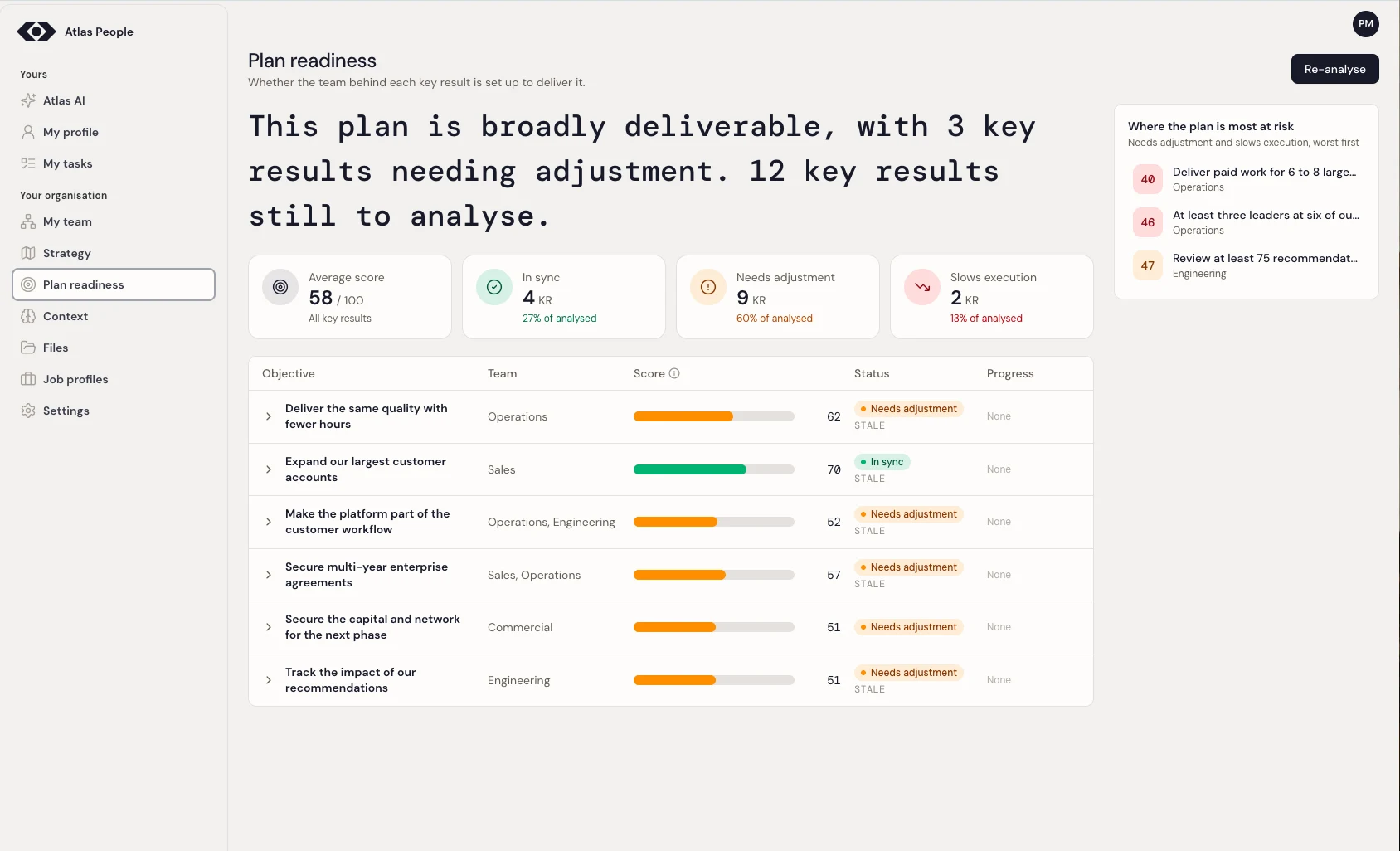
A time-bound assessment of one defined plan, made before the decision is fixed. It shows whether the organisation can deliver, what may get in the way, and what to address first.
- ✓Decision named
- ✓Accountable leader named
- ✓Review date agreed before the outcome
One plan, assessed before the decision is fixed.
Atlas shows leaders whether their organisation can deliver the plan, what could get in the way, and what to address first. An Execution Forecast applies that method to one defined plan before the commitment is fixed.
When the change is funded and delivery matters.
Not every plan needs a forecast. A forecast earns its place when money has been committed to a change, when the deadline is fixed, and when a named leader carries the consequence if it slips.
- ▫Assessment34 dimensions
- ▫SurveyWorking patterns
- ▫Approved contextRoles, decision rights, incentives
- ▫InterviewsLeaders and teams
The plan, and the people expected to deliver it.
The evidence combines Atlas's assessment and survey with approved organisational context, including roles, decision rights, incentives, interviews and working patterns. No single source is treated as the truth.
Broadly deliverable. Three decisions cross the old boundary and none has an owner yet.
A rated view you can act on, and defend.
Each rating carries the evidence behind it, the uncertainty around it, a recommended next move, and a review date. The ratings describe the arrangement around a person, never the person.
- COOwns the outcomeChief Operating OfficerOwner
- DLCarry the planSeven division leadersAssessed
- APValidates every findingAtlas expertReview
The leader who owns the outcome.
The engagement is anchored with the leader who owns the consequence. The leaders and teams expected to carry the plan take the assessment and survey. Atlas experts conduct the reading and validate every finding before it reaches the client.
- Bounded to this plan, this arrangement, this period
- Never a prediction about a person
- No accuracy claim until the record justifies it
What we will not claim.
A forecast is time-bound, never absolute. It covers this plan, this arrangement, and a defined period, with a review date set at the start. It is never a prediction about a person's future. When the plan or context changes materially, Atlas updates the judgement through an Execution Reforecast.